From Racing Roots to NASA’s Rigorous Selection Process
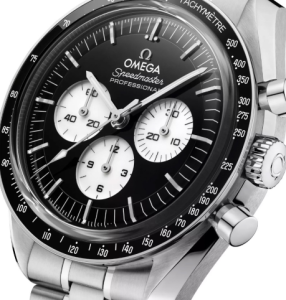
The Speedmaster’s origins are grounded not in space, but on the racetrack. Launched by Omega in 1957 (ref. CK 2915), it was engineered for professional motorsport drivers, built to deliver precise, legible timing at 120 mph. Its signature features — the high-contrast black dial, broad arrow hands, tachymeter bezel, and robust manual-wind movement — were designed to withstand the vibrations, shocks, and extreme temperatures of competitive racing. No one at the time could have predicted it would soon face far harsher conditions.
In the early 1960s, as the U.S. space program raced to land a man on the moon, NASA realized its astronauts needed a wristwatch that could survive the brutal realities of space travel. The High Quality Omega Replica Watches agency’s procurement team secretly purchased chronographs from top Swiss brands — Rolex, Longines, Heuer, and Omega — off the shelf, no special modifications, and subjected them to a battery of tests so extreme no off-the-shelf consumer watch had ever faced them.
The requirements were almost absurdly unforgiving:
Temperature cycling: 48 hours at 160°F (71°C), followed by 30 minutes at -4°F (-20°C), then repeated at 200°F (93°C) for 6 hours, to simulate the wild swings of direct sun and shadow in orbit.
Vibration testing: 30 minutes of intense vibration across 5 to 2000 Hz frequencies, mimicking the violent shake of a Saturn V rocket launch.
Shock resistance: 40 blows of 10g force, designed to replicate the jolt of a spacecraft docking or unexpected impact with debris.
Vacuum exposure: 48 hours in a near-total vacuum at 140°F (60°C), to test for oil evaporation and case seal failure.
Most of the competing Omega Replica Watches cracked, fogged, lost critical time, or stopped entirely. Only the Omega Speedmaster passed every single test, without a single fault. On March 1, 1965, NASA officially announced the Speedmaster as its certified chronograph for all manned space missions. The “Moonwatch” was born.
The Apollo Legacy: Beyond the First Step
The Speedmaster earned its iconic nickname barely four years later, when Neil Armstrong and Buzz Aldrin strapped their Speedmasters to their EVA suits before stepping onto the lunar surface on July 20, 1969. In a little-known twist, Armstrong’s Speedmaster stayed behind in the Apollo 11 command module, used as a backup timing device after the craft’s onboard navigation system glitched — making Aldrin the first human to wear a watch on the moon. That same ref. 105.012 Speedmaster, lost during a transit to the Smithsonian Institution decades later, remains one of the most famous missing artifacts in horology.
But the Moonwatch’s most legendary moment came not from a successful landing, but from disaster. In 1970, the Apollo 13 mission suffered a catastrophic oxygen tank explosion 200,000 miles from Earth, crippling nearly all the spacecraft’s onboard systems. The crew was forced to use their lunar module as a makeshift lifeboat, and to execute a critical, precise 14-second manual engine burn to set their trajectory back to Earth — a maneuver that required perfect timing, because the module’s digital timers had failed. Commander Jack Swigert’s Speedmaster was the only device that could deliver the exact timing needed. The burn worked, and the crew returned safely to Earth. For that act of life-saving precision, Omega was awarded the prestigious Silver Snoopy Award — the highest honor bestowed by NASA’s astronauts, a recognition that the brand still celebrates in limited-edition Speedmaster releases today.
Of the 12 astronauts who walked on the moon, every single one wore a Cheap Omega Replica. It has logged over 10,000 hours of extravehicular activity, survived 6 Apollo missions, and even flew on NASA’s Space Shuttle program, remaining flight-qualified for manned space travel to this day.
The Timeless Design That Transcended Eras
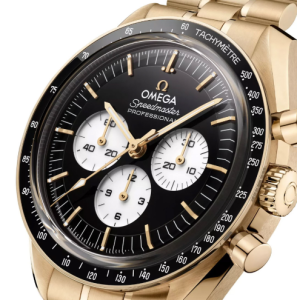
What makes the Moonwatch so enduring, even for people who have never stepped foot near a rocket? Its core design has barely changed in nearly 60 years, a rare feat in an era of constant product updates. The modern Speedmaster Professional (the iconic “Moonwatch” model) still retains the 42mm stainless steel case, the manually wound movement (the Calibre 3861, a METAS-certified master chronometer that delivers anti-magnetic resistance up to 15,000 gauss), the signature hesalite crystal (a scratch-prone but shatter-resistant acrylic that astronauts used in space), and the asymmetric case that protects the crown and chronograph pushers from accidental damage during EVA.
It’s a watch that refuses to cater to fleeting trends. Unlike many modern luxury timepieces that bloat to 46mm or more to make a statement, the Moonwatch wears perfectly on almost any wrist, balancing rugged tool-watch functionality with understated elegance. It works just as well paired with a formal tuxedo at a black-tie gala as it does with a worn-in flight jacket on a weekend road trip — a versatility that has made it a favorite of everyone from James Bond (it appeared in GoldenEye and Casino Royale) to world leaders, celebrity collectors, and generations of watch enthusiasts.
The cultural impact of the Moonwatch extends far beyond horology. It has appeared in countless films, been carried to space by private civilian astronauts, and even hangs in the permanent collection of the Museum of Modern Art as a design icon, celebrated for its perfect fusion of form and function. For millions of people, it’s not just a extraordinary copy omega watch— it’s a wearable piece of 20th century human achievement, a reminder that ordinary tools can become part of history when they’re built to exceed every possible expectation.
The Moonwatch Today: A Legacy That Keeps Reaching New Heights
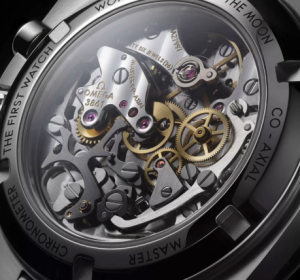
In 2025, the Omega Speedmaster is more relevant than ever. As NASA’s Artemis program prepares to send the first woman and person of color to the moon, 50+ years after the last Apollo mission, the Speedmaster will once again be strapped to astronauts’ wrists, ready to mark the next chapter of lunar exploration. Omega has updated the classic model with modern improvements — the Calibre 3861’s 50-hour power reserve, anti-magnetic technology, and certified precision — without erasing any of the nostalgic, soulful details that make it a Moonwatch. The iconic “Dot over 90” tachymeter bezel, the textured step dial, the luminescent broad arrow hands that glow long after dark: all of the small, beloved quirks that have defined the model for generations remain.
For new collectors, the Omega Replica Watches Online is often the first “grail watch” on their list — accessible enough to be attainable for dedicated enthusiasts, yet steeped in enough history to feel meaningful, not just a status symbol. For long-time horology fans, it’s a reminder of what a mechanical watch is supposed to be: a reliable, hand-assembled instrument that connects you to a timeline of human curiosity and courage.
Final Thoughts: The Watch That Went Where No One Had Gone Before
What makes the Fake Omega Speedmaster Moonwatch different from every other luxury watch on the market? It’s not the price tag, not the marketing, and not just the famous name. It’s the fact that it didn’t just witness history — it helped make it. It survived rocket launches, moon walks, and a life-or-death emergency 200,000 miles from home, all while keeping perfect time.
Wearing a Moonwatch isn’t just about wearing a beautiful, well-made chronograph. It’s about strapping a piece of that legendary 1960s ambition to your wrist: the belief that human ingenuity, and a tool built to outperform every possible limit, can take us to places no one ever thought we could reach. For 60 years, it’s stayed true to that mission — and as we set our sights back on the moon, and even Mars, the Speedmaster will be right there, ticking, every step of the way.